The culturally competent teacher should be able to use a variety of assessment techniques appropriate to diverse learners and accommodate socio-cultural differences that affect learning.
The classroom that I have been volunteering is called the "Math "Office" and hosts all the students who are struggling with math, which is at times a great deal of the students. Like I mentioned in the previous post, this is a turnaround school, so the curriculum is made to start off at a lower level, but also progresses quickly. Because of this there is a lot of RTI, which really depends on frequent and consistent assessments. There are many different types of assessments. You can see from the statistics previously talked about, the classrooms are very diverse. In fact, none of the students I have worked with in my first 8 hours of service are white. I have realized that a good amount of the students there are not fluent in reading and writing. A few that I talked to are not even very fluent in speaking. As we learned in class, good fluency is needed for basic comprehension. Mrs. Johnson had realized that, and while giving a 14 problem assessment today, offered to have a table where the instructions were read to you. All but two students elected for this and we had to do a table of students each. She made sure that students understood that whoever asked for spoken instruction was eligible for the same treatment on the NECAP, which is one vital assessment for overall progress. I worked with a table of 5 students, who really liked the reading of the instruction out loud. Three of them practically didn't even need the verbalization, one of them needed it a little, the verbal cues reminded him of what it was asking for, and then there was one student who I could tell could not understand the math terms, even when I explained what they were. He got a couple right on the assessment, but I noticed that he was just guessing on most, if not all. The ones with graphs were not too bad for him, but making a graph from instruction was very tough for him. If he can't remember what a term means, how is he going to do the steps to determine the value of that term for that specific problem?
Sometimes the written assessments do not work well at all. Mrs. Johnson had found a website, called sumdog.com, which was a series of games which revolved around math problems. The games ranged from racing to football, in order for the car to move or to get past the tackler, the answer had to be found. The website records all of the student responses, and for a small fee, the teacher can get all the data from the student's games. There are many advantages to this website: the software is adaptive, it adjusts difficulty based on correct or incorrect answers; since it is a website, it can be used at home, more data can be gathered; but probably one of the best reasons for use of this is that students get excited about using it, "Sumdog time" is actually a reward. Mrs. Johnson uses this tool to gather information, she found out that some students who scored very low on the paper assessments, actually do quite well during the computer games. It shows how some students do have more capability than can be measured on a typical paper "test" and students can gain confidence, which is sometimes all they need. Lastly, a very welcome surprise was presented to Mrs. Johnson when she viewed the data for some of her younger students. There were at least two students who had mastered addition, and actually started to learn multiplication, something not even taught yet. They didn't know why 2x2=4, but they did know that 2x2=4.
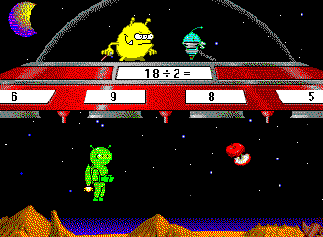
(The picture is a screenshot from my favorite computer game as a kid "Math Blaster")
(The picture is a screenshot from my favorite computer game as a kid "Math Blaster")

Hi Shanon,
ReplyDeleteI've enjoyed reading your posts. I really liked how you correlated your own memories of learning French and watching French videos to your service learning experience. It's wonderful that the teacher incorporated this as a part of the student's learning too. She's quite creative with the use of "Sumdog." It sounds like you've been given a great teacher who can pass on a lot of valuable information. I'm so glad for you! I can't wait to read your next post. :)
Love the visual! Hopefully you can explore many math games websites to help increase the variety of assessment and learning opportunities for a wide diversity of learners!
ReplyDelete