Friday, June 1, 2012
How Has This Shaped My Identity?
Well, to start off, I have never had much interaction with urban children, nevermind teaching them algebra or addition. I don't feel totally prepared to be student teaching in January, but I do feel more comfortable. I have been surprised at many things, like a kinder-gardener doing math at 2nd grade level with some traits of 6th grade level. I never thought that "under-achieving" students could start formulating algebraic inequalities in 4th grade. But not all were good surprises, like finding out that a 4th grader couldn't read, or finding out a 3rd grader was struggling with addition. I guess my point is that there are so many different levels that students are at, mentally and socially. But I've also learned that in a good school, in a good system with administrators, teachers and specialists all working together, that a good deal of learning can be done, students and teachers. Through reading about other people's experiences, I have learned that it does "take a village" and that not all teachers are awesome, and instead of judging, to reflect on it and learn from it. Not that I didn't doubt this before, but I have learned that it is a lot of work to be a teacher, but if you put in the work, and have a mutually respective relationship with the students, teaching can be very rewarding. I have finished my obligation for this class, but I have already talked to the teacher about continuing until the end of the year, and starting again in the fall.

Wednesday, May 30, 2012
Sensitivity to linguistic differences
The culturally competent teacher communicates in ways that demonstrate sensitivity to socio-cultural and linguistic differences, using a variety of verbal and non-verbal communication techniques that encourage positive social interaction and support learning in their classroom.
One of the things that I like about working with math is that it is pretty universal, there are not too many language barriers, however, there can still be problems with language barriers. There are a lot of verbal communication techniques that the school uses to help students. A few of them I have already talked about in previous posts, like reading out loud directions to small groups and having ESL teachers in some classrooms. One exercise that 3rd graders do is looking at a 6 digit number and read what it is, which helps with places, but also with the actual numbers. And because there is a good deal of direct instruction, most of the other communication techniques are non-verbal.
One of the most prominent non-verbal techniques used is the use of posters on the walls. In the math office, there are graphics and posters with information, like the three averages and their definitions. There are large number-lines and calendars for everyone to see and use. There are lots of graphs and most assignments are written on the whiteboard on a place set aside for them. Last Friday I helped with a really successful using non-verbal methods to create an advance organizer for algebra, which was going to be taught next week. The idea was to introduce algebra as literally balancing two sides of an equation, where a fulcrum was the place where the equal sign was placed. There were three different stations, each for a group of 6 students. The first had a lever on a fulcrum in the middle, with hooks along increments and a set of weights of equal mass. The weights were placed at various places on one side, and the students had to balance it using certain constraints. From the distance fulcrum and the number of weights on a hook, the students formed equations from the balanced lever. The second station was very similar, it had a balance with a set of two different weights, where the students had to level the balance and form an equation. The students had a little trouble at first, but after a little guidance, were doing very well. The third station had laptops, where the students "played" at sumdog.com, practicing their basic math operations and getting instant feedback from the computer.
One of the things that I like about working with math is that it is pretty universal, there are not too many language barriers, however, there can still be problems with language barriers. There are a lot of verbal communication techniques that the school uses to help students. A few of them I have already talked about in previous posts, like reading out loud directions to small groups and having ESL teachers in some classrooms. One exercise that 3rd graders do is looking at a 6 digit number and read what it is, which helps with places, but also with the actual numbers. And because there is a good deal of direct instruction, most of the other communication techniques are non-verbal.
One of the most prominent non-verbal techniques used is the use of posters on the walls. In the math office, there are graphics and posters with information, like the three averages and their definitions. There are large number-lines and calendars for everyone to see and use. There are lots of graphs and most assignments are written on the whiteboard on a place set aside for them. Last Friday I helped with a really successful using non-verbal methods to create an advance organizer for algebra, which was going to be taught next week. The idea was to introduce algebra as literally balancing two sides of an equation, where a fulcrum was the place where the equal sign was placed. There were three different stations, each for a group of 6 students. The first had a lever on a fulcrum in the middle, with hooks along increments and a set of weights of equal mass. The weights were placed at various places on one side, and the students had to balance it using certain constraints. From the distance fulcrum and the number of weights on a hook, the students formed equations from the balanced lever. The second station was very similar, it had a balance with a set of two different weights, where the students had to level the balance and form an equation. The students had a little trouble at first, but after a little guidance, were doing very well. The third station had laptops, where the students "played" at sumdog.com, practicing their basic math operations and getting instant feedback from the computer.
Thursday, May 24, 2012
Teaching After Brown vs Board of Education
Think about how institutional racism is anchored in our society and feeds internalized racism in the way Wise analyzes it, and what the impact might be on Black and Brown students' approach to schools - Delpit's Culture of Power - and school achievement. Think about segregation/desegregation/re-segregation in the way Kozol/Kirp analyze it. Think about what you are observing in your tutoring site. Think about what "actual diversity" means, and how everyone (race, ethnicity, class, gender identity, sexual orientation, body ability, religion, etc) might benefit from a completely desegregated and truly diverse school environment.
It is painfully obvious that there is still institutionalized racism in this country, simply because of the shocking of statistics. I remember being taught in school the victories of civil rights when Plessy v Ferguson was overturned by Brown v BOE and the great progress we as a country had made since the 60s. However, when I look at the statistics presented by Kirp and Kozol, we have started to slip and go backwards. When I see information like "The achievement gap between black and white children...started to widen once more in the early 1990s when the federal courts began the process of resegregation by dismantling the mandates of the Brown decision." (Kozol 10).
Some might say that statistics don't tell the whole story, which is why many have done studies with people, surveying and simply asking questions. When Kozol went to talk with some of the black students in a high school in LA, the first thing the student mentioned was the bathrooms. There were "fifteen fewer bathrooms than the law requires" (Kozol 8). This is just shocking and brings me to Maslow's hierarchy, the fact that if the students are not physically satisfied, they will never have any desire or motivation to learn nor better themselves. Something that most people take for granted, others have to worry about, preventing them from even absorbing anything in school. The student goes on to explain how she wanted to take AP classes, to better herself through college so she doesn't have to be a seamstress like her mother. However, she is quickly put down by a fellow black student, explaining "You're ghetto-so you sew!".
The institutionalized discrimination and prejudice starts very young, as demonstrated by the doll experiments conducted by Dr. Kenneth Clark in the 60s. The young children picked out the white dolls as "nice", "pretty", and "good" and the black dolls as "bad". The black students were also very hesitant to pick out the one that was most like them, especially after saying the darker skinned dolls were "bad". When this experiment was performed in the 80s and 90s, the same results were obtained, indicating a huge lack of progress. Another experiment performed was by Jane Elliot, in an all white classroom, where for a day she discriminated by eye color, making a certain eye color wear collars and constantly berated them, associating their eye color with substandard behavior and the other eye color with superiority. She found that the students who were wearing the collars performed worse on the same assessment than the students without. The next day she reversed the experiment, and found the same result.
When I look at the classroom where I am volunteering, it is not as diverse as it is labeled, there are no white students to be found, at least I didnt see any. This is not "actual diversity", just like Kozol mentions. If students were truly unsegregated, everyone would benefit, since children are not empty glasses to be filled up but people with their own culture to share. I also believe that the achievement gaps would start to narrow and people would become more culturally aware, the first step needed to ending institutionalized racism.
Wednesday, May 23, 2012
Assessing The Students
The culturally competent teacher should be able to use a variety of assessment techniques appropriate to diverse learners and accommodate socio-cultural differences that affect learning.
The classroom that I have been volunteering is called the "Math "Office" and hosts all the students who are struggling with math, which is at times a great deal of the students. Like I mentioned in the previous post, this is a turnaround school, so the curriculum is made to start off at a lower level, but also progresses quickly. Because of this there is a lot of RTI, which really depends on frequent and consistent assessments. There are many different types of assessments. You can see from the statistics previously talked about, the classrooms are very diverse. In fact, none of the students I have worked with in my first 8 hours of service are white. I have realized that a good amount of the students there are not fluent in reading and writing. A few that I talked to are not even very fluent in speaking. As we learned in class, good fluency is needed for basic comprehension. Mrs. Johnson had realized that, and while giving a 14 problem assessment today, offered to have a table where the instructions were read to you. All but two students elected for this and we had to do a table of students each. She made sure that students understood that whoever asked for spoken instruction was eligible for the same treatment on the NECAP, which is one vital assessment for overall progress. I worked with a table of 5 students, who really liked the reading of the instruction out loud. Three of them practically didn't even need the verbalization, one of them needed it a little, the verbal cues reminded him of what it was asking for, and then there was one student who I could tell could not understand the math terms, even when I explained what they were. He got a couple right on the assessment, but I noticed that he was just guessing on most, if not all. The ones with graphs were not too bad for him, but making a graph from instruction was very tough for him. If he can't remember what a term means, how is he going to do the steps to determine the value of that term for that specific problem?
Sometimes the written assessments do not work well at all. Mrs. Johnson had found a website, called sumdog.com, which was a series of games which revolved around math problems. The games ranged from racing to football, in order for the car to move or to get past the tackler, the answer had to be found. The website records all of the student responses, and for a small fee, the teacher can get all the data from the student's games. There are many advantages to this website: the software is adaptive, it adjusts difficulty based on correct or incorrect answers; since it is a website, it can be used at home, more data can be gathered; but probably one of the best reasons for use of this is that students get excited about using it, "Sumdog time" is actually a reward. Mrs. Johnson uses this tool to gather information, she found out that some students who scored very low on the paper assessments, actually do quite well during the computer games. It shows how some students do have more capability than can be measured on a typical paper "test" and students can gain confidence, which is sometimes all they need. Lastly, a very welcome surprise was presented to Mrs. Johnson when she viewed the data for some of her younger students. There were at least two students who had mastered addition, and actually started to learn multiplication, something not even taught yet. They didn't know why 2x2=4, but they did know that 2x2=4.
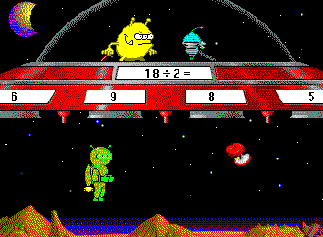
(The picture is a screenshot from my favorite computer game as a kid "Math Blaster")
(The picture is a screenshot from my favorite computer game as a kid "Math Blaster")
Saturday, May 19, 2012
Prompt 2 Response: Social Differences in the Classroom
The culturally competent teacher should be able to account for, demonstrate awareness of, and respond to the socio-cultural distinctiveness of her or his students, families, and communities when planning for and delivering instruction.
During the time I have worked with these students I am starting to pick up the socio-cultural distinctiveness of the classes. Most of the students speak fluent English, some speak well enough to know what is going on, and a few kids are lost a decent amount of time. However, this doesn't mean that most of the students understand completely. I am learning that just about all the students learned English verbally, which is definitely instrumental, but formal language training is lacking. This can lead to students having to learn more terms in school, which can slow the math learning process. There is also the problem that the home is not a place where students can get better at English, I am learning a lot of students are first generation English learners. The school and Mrs. Johnson have responded by making sure students and parents know about and have access to many resources, inside and outside of school. When I went to a second classroom to help the teacher, I noticed that there was a second teacher in the room, who I correctly guessed was an ESL teacher, allowing for translation when necessary. Another method that the teachers used was the use of videos, both for teaching subject matter, but also with language skills. I remember when I was in France, the French college students loved to watch movies in English because it helped them to learn the language. It is very cool to see thing being done in school. For the students that were not yet there in English, they received all the Tier 1 instruction, but during their time with Mrs. Johnson (and me), they received different types, mostly visual and audio combined, with constant feedback, to make sure the students understood. We also started to use a website, which contained math games that the students could use, which got them excited about practicing their math. I worked with a 3rd grade student who did not score very well on his assessments, but seemed to do well with 1-on-1 learning, we were rolling 3 dice and getting all the combinations, he didn't know what to do, but I explained it and he got it right away. I was also instructed to ask him to say the numbers, and to see how many number places he knew, which was all the way to the millions. I even added a 4th die and he did well.
Overall, I have noticed that there is a lot of scaffold teaching going on. The teachers are meeting the students where they are, and making sure to give them the support they need, while slowly getting more complex and less heavily involved.
Saturday, May 12, 2012
Introduction to the school
Today was my first day volunteering at Wayside Elementary, and it was a very interesting experience from the start. When I walked in, it was very bright, walls in pastel colors and street signs in all the hallways. The school was modeled as a town and helped to teach addresses and giving directions. The next thing that really stuck out was a bunch of large posters, showing the NECAP scores, and this school did not score very well. I was a bit confused about why they were displayed so openly to parents and visitos, so I asked Mrs. Johnson, and like the RIDE statistic website name implies, information is key. She said they should not be ashamed of where they are, that everyone has to start somewhere, that progress is something to be proud of.
The demographics of the school are a typical urban school very close to the demographic of the surrounding area: almost 60% Hispanic, over 25% African American and under 5% Caucasian. Almost all the students qualify for subsidized lunch, and half receive ESL services, 10 times the state average. However, unlike the surrounding area, the school had an affluent look to it, it stuck out from the surrounding buildings. The school had been recently renovated and was well maintained, they were trying to create a place where students felt not only comfortable but proud to attend. This did not always work, as chronic absenteeism is far above the state average. The school as a whole did not make sufficient progress last year, the closest percentage points difference was 29 points below the state average.
The school had a very different feeling than I am used to in schools. There was a very comfortable atmosphere, the teachers wore mostly t-shirts with the school's logo. I worked with all female teachers, but none of the students, male or female had any problem hugging the teachers. There was a definite sense of respect, the students understood that when they were misbehaving, they would be corrected and almost always listened.
By the way, Mrs. Johnson was not a typical elementary teacher, she was actually the math specialist for the entire school. From what I understand, everything she does is mostly Tier 2 and 3, but she works with a majority of the students because this is considered a "turnaround school". She was very caring and was adamant about doing her best to help the students, she even pointed out to me when she made mistakes. She was not afraid to reward good behavior or take away privileges. She also had bottled water and fruit in her fridge for the students.
In general, the school seemed like it was a great place for those students who need extra help, they try to find a model to best teach the student, but at the same time, make sure that progress is made.
All numbers were gathered from http://infoworks.ride.ri.gov
The demographics of the school are a typical urban school very close to the demographic of the surrounding area: almost 60% Hispanic, over 25% African American and under 5% Caucasian. Almost all the students qualify for subsidized lunch, and half receive ESL services, 10 times the state average. However, unlike the surrounding area, the school had an affluent look to it, it stuck out from the surrounding buildings. The school had been recently renovated and was well maintained, they were trying to create a place where students felt not only comfortable but proud to attend. This did not always work, as chronic absenteeism is far above the state average. The school as a whole did not make sufficient progress last year, the closest percentage points difference was 29 points below the state average.
The school had a very different feeling than I am used to in schools. There was a very comfortable atmosphere, the teachers wore mostly t-shirts with the school's logo. I worked with all female teachers, but none of the students, male or female had any problem hugging the teachers. There was a definite sense of respect, the students understood that when they were misbehaving, they would be corrected and almost always listened.
By the way, Mrs. Johnson was not a typical elementary teacher, she was actually the math specialist for the entire school. From what I understand, everything she does is mostly Tier 2 and 3, but she works with a majority of the students because this is considered a "turnaround school". She was very caring and was adamant about doing her best to help the students, she even pointed out to me when she made mistakes. She was not afraid to reward good behavior or take away privileges. She also had bottled water and fruit in her fridge for the students.
In general, the school seemed like it was a great place for those students who need extra help, they try to find a model to best teach the student, but at the same time, make sure that progress is made.
All numbers were gathered from http://infoworks.ride.ri.gov
Wednesday, May 9, 2012
Introduction
Hey Everyone, this semester, as part of my FNED 546 course at RIC with Prof Mattiauda, I will be volunteering at an elementary school in Providence RI. As part of the course, but also as a tool to help improve my teaching ability and skills, I will blog about my experiences at this school, hoping to become a more culturally competent teacher. For security reasons I am using pseudonyms for the school, which I will call "Wayside Elementary", working with "Mrs. Johnson" helping out with math in grades 2-5.
As far as about me, I am not a typical education grad student. I graduated from IIT in Chicago with a BS Electrical Engineering back in 2010. Since then I have realized, with the help of many others, that I really enjoy being with children, especially teaching them, since I have always had a passion for learning and would like to share it with them. I currently have a part time job at Lowe's in Warwick and enjoy hanging out with friends, movies, sports and video games.
As far as about me, I am not a typical education grad student. I graduated from IIT in Chicago with a BS Electrical Engineering back in 2010. Since then I have realized, with the help of many others, that I really enjoy being with children, especially teaching them, since I have always had a passion for learning and would like to share it with them. I currently have a part time job at Lowe's in Warwick and enjoy hanging out with friends, movies, sports and video games.
Subscribe to:
Posts (Atom)